Visual Instruction Data Selection
DICS: Exploring Data Intrinsic Consistency for Visual Instruction Selection
Select less. Learn more.
1 University of Chinese Academy of Sciences
2 Institute of Automation, Chinese Academy of Sciences
3 Alibaba Token Hub, Alibaba Group
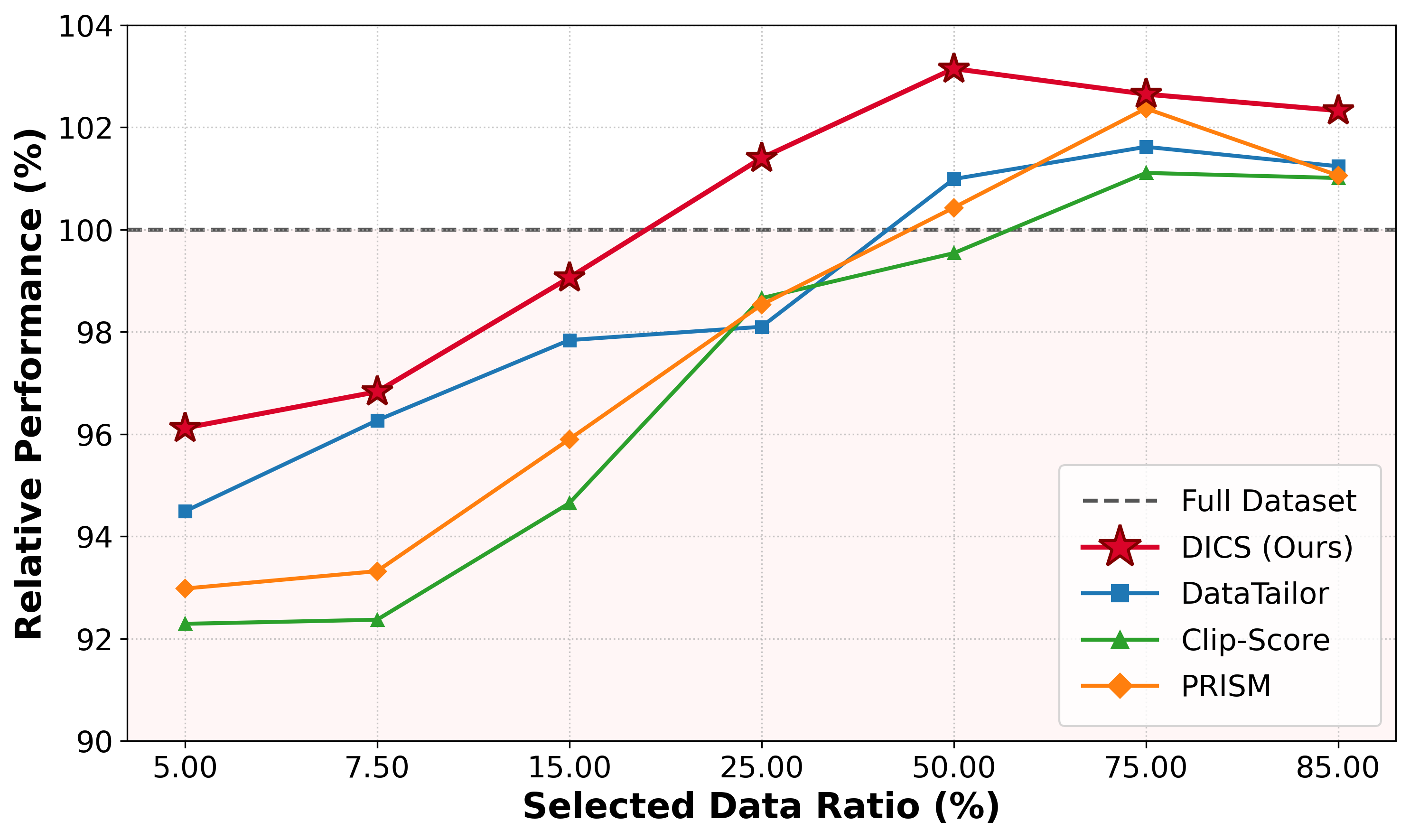
DICS consistently leads competing selection methods and surpasses full-data fine-tuning from only 25% of LLaVA-1.5-665K.
01 / Motivation
Quality begins inside each sample.
Abstract
Visual instruction tuning is crucial for advancing the vision-language alignment and instruction-following capabilities of Vision-Language Models. Yet, identifying optimal subsets under a fixed data budget remains a significant bottleneck.
We introduce Data Intrinsic Consistency (DIC), a self-scoring metric that measures sample-level consistency among the image, instruction, and response. Building upon DIC, Data Intrinsic Consistency Selection (DICS) adaptively balances high intra-sample consistency with global distributional diversity across data budgets.
Across datasets and model architectures, DICS consistently outperforms state-of-the-art selection methods—surpassing full-dataset fine-tuning with only 25% of LLaVA-1.5-665K.
02 / Method
Two views of intrinsic consistency.
DIC uses the model itself to quantify how much each component contributes—without relying on an external evaluator.
01
Visual Information Consistency
Does the image provide essential information for producing the response? VIC contrasts response losses with and without visual context.
VIC = ℒ(response | instruction) − ℒ(response | image, instruction)
02
Response Information Consistency
Is the response focused, accurate, and coherent with the instruction? RIC measures how the response helps recover the original instruction.
RIC = ℒ(instruction | image) − ℒ(instruction | image, response)
03
Data Intrinsic Consistency
A high-quality sample must be strong from both perspectives. The stricter dimension determines its final intrinsic consistency.
DIC = min(VIC, RIC)
Adaptive selection
Consistency meets diversity.
At low selection ratios, DICS prioritizes high-DIC samples while preserving broad coverage through farthest-point sampling. At high ratios, it removes low-consistency samples with redundant features.
Visual instruction
dataset
→
dataset
VICRICDIC
→
Diversity-aware
sampling
→
sampling
Optimal
subset
subset
03 / Results
More performance from less data.
LLaVA-1.5-665K · 25%
DICS is the only 25% selection method to beat full-data training.
Using 166K samples, DICS reaches 101.40% relative performance and leads on MMBench-CN, DocVQA, InfoVQA, and POPE.
- DocVQA24.64
- InfoVQA23.11
- POPE84.91
DICS-6M · InternVL3-8B
Consistency scales to millions.
At 1.5M samples, DICS already outperforms full 6M training. At 5.1M, it reaches 103.10% relative performance.
04 / Takeaways
Simple principle. Broad impact.
Sample-level metric
DIC jointly measures visual and response consistency with one self-scoring paradigm.
Budget-aware selection
DICS adapts the quality–diversity trade-off to the requested subset size.
Robust at scale
Consistent gains across datasets, architectures, data scales, and evaluation capabilities.
05 / Citation
Cite DICS.
@misc{hong2026dics,
      title={DICS: Exploring Data Intrinsic Consistency for Visual Instruction Selection},
      author={Yuyang Hong and Jinhui Guo and Jiaqi Gu and Lubin Fan and Ruixiang Wang and Kun Ding and Yue Wu and Shiming Xiang and Jieping Ye},
      year={2026},
      eprint={2608.30209},
      archivePrefix={arXiv},
      primaryClass={cs.CV},
      url={https://arxiv.org/abs/2608.30209},
}Preliminary citation; venue and publication fields will be updated after the paper is released.